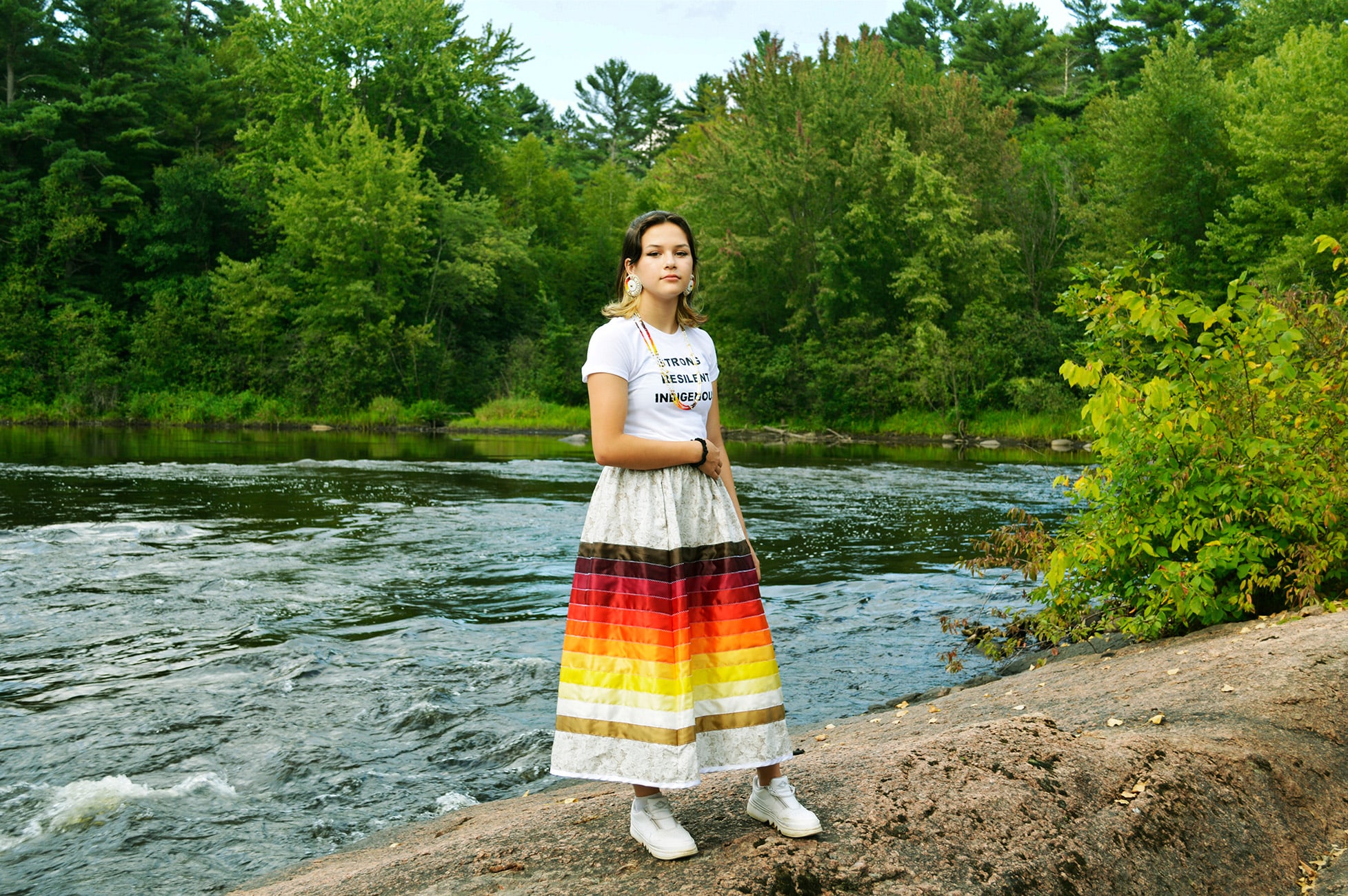
From her home on the Memoninee Nation reservation, 13-year-old national boxing champion Ayanna O’Kimosh posts on social media the missing posters for indigenous women nationwide with a simple message: “Have you seen her?”
Whether in the boxing ring or on Facebook and Instagram, the eighth grader from Keshena, Wis., fights to shine a light on missing and murdered Indigenous women and girls, or MMIWG, as the cause is known. Wearing a white T-shirt emblazoned with the words “STRONG RESILIENT INDIGENOUS,” she spoke about her journey as a boxer and activist in her keynote speech for Alverno’s third annual State of Wisconsin Girls Summit in October.
During her keynote, O’Kimosh shared a favorite quote by boxing legend Muhammad Ali: “We can’t be brave without fear.” She recounted how she initially dissolved into tears after every sparring match, but soon conquered her nerves as well as her opponents.
Outside the ring, O’Kimosh stepped outside of her comfort zone by using her platform to amplify the MMIWG cause. During the 2019 USA Boxing Nationals, she pledged to fight for missing and murdered Indigenous girls.
“I wanted to fight for them and to change the narrative for future generations,” said O’Kimosh, who is a member of the Oneida Nation and descended from the Menominee and Arikara tribes.
Her Menominee name, Naenawehtawukiw, means Warrior Woman. Her determined spirit comes through in a photo in which she wears a traditional ribbon skirt made by her mother and a T-shirt with the words “War Ready,” with her hands wrapped in boxing tape. A painted handprint covers her face as a a symbol of the MMIWG movement.
The cause is personal to O’Kimosh. In 2020, her relative, 22-year-old Katelyn Kelly, went missing. Kelly’s remains were found on the Menominee reservation in March 2021, the case still unsolved.
O’Kimosh shared the stark statistics: Indigenous women face murder rates more than 10 times higher than the national average and significantly higher rates of violence. And those are only the reported cases. A 2016 report by the Urban Indian Health Institute counted 5,712 MMIWG cases, only 116 of which were logged by the U.S. Department of Justice database.
“Native women go missing three times: physically, in the data and in the media,” O’Kimosh noted.
In addition to using social media and media interviews to spread her message, O’Kimosh has presented about MMIWG at her school and participated in a discussion panel on the topic with two professional women boxers, Kali Reis and Ronica Jeffrey. She hopes to teach self-defense to girls as a preventative measure.
“I’m most proud of my role as an advocate of change,” she said. “It gives me a very empowering feeling to teach these young girls and women about this issue, and it drives me to do more to keep spreading this awareness.”
Learn more
You can watch a video of O’Kimosh’s speech and find other resources related to the MMIWG epidemic here.
This article appears in the winter 2022 issue of Alverno Magazine.